Every charger at your office is taken by 8:05 a.m., and the cars on them will sit there until 5 p.m. The driver who arrives at 9 running low files a complaint, and the complaint becomes a request for more ports. Before you approve it, write a workplace EV charging policy, because most charger fights are a scheduling problem dressed up as a hardware shortage.
- By our calculation from federal data, a typical US commute of about 13.5 miles each way needs roughly 1 to 2 hours on a 7.2 kW Level 2 port, well under a workday.
- A port held all day serves one driver. By our arithmetic, the same port in 2-hour bookable slots can serve up to four, if cars move.
- Demand is outpacing ports: on ChargePoint's network, CBRE reports twelve drivers per active workplace port in 2023, against eight before the pandemic.
- By the same math, time-sharing breaks down on low-power ports near 2.9 kW, where a heavy EV needs 4.5 hours or more for one commute.
What is a workplace EV charging policy?
It is the page that decides who gets the plug, and for how long.
A workplace EV charging policy is a short set of rules that decides who may use the employer's chargers, for how long, and what happens when a car overstays. A good one time-boxes sessions, requires moving the car when charging ends, sets priority for drivers who need the charge, and names an enforcement path.
Without one, the rule defaults to first come, first served. Even the DOE sample workplace charging policy, published in 2015, starts there. That default is what produces the 8 a.m. race.
Why the 8 a.m. race is not a hardware problem
Demand at the plug has grown faster than the plugs. Using ChargePoint network data, CBRE reports an average of twelve drivers per active workplace port in 2023, against eight before the pandemic. Unique drivers charging at work rose 57% and sessions 64% that year, while active ports grew 22%. The data covers one charger vendor's network, so read it as a direction.
The morning rush is not only about the ports you have. It is also about the ports drivers expect to find taken. In a field experiment with 629 EV drivers at UC San Diego in 2023 and 2024, a larger discount raised workplace charging by 24%, but expected competition for ports pushed some sessions into the early morning and overnight (study summary). Drivers who expected more colleagues to get a discount moved their own sessions out of the congested early morning, even though their own price had not changed.
EV growth has also slowed. The IEA puts US electric car sales at around 10% of the 2025 market, and Cox Automotive counts EVs at 5.7% of new-vehicle sales in August 2026. Get more from the ports you own before you ask for capital.
How long does a commute charge actually take?
The 2022 National Household Travel Survey puts the average commute trip by privately owned vehicle at 13.56 miles one way, according to FHWA. Call it about 13.5 miles each way, or 27.1 miles a round trip. The 2022 sample was small, so treat it as approximate.
The EPA rates a 2025 Tesla Model Y at 27 to 32 kWh per 100 miles and a 2022 Ford F-150 Lightning, a fair heavy-EV bound, at 48 to 51. By our arithmetic, a day's commute therefore takes 7.3 to 8.7 kWh in the Model Y and 13.0 to 13.8 kWh in the Lightning.
The DOE Alternative Fuels Data Center puts a typical residential Level 2 unit at 7.2 kW, within a Level 2 range of 2.9 to 19.2 kW, and approximately 25 miles of range per hour of charging. Commercial units typically run at 208 volts, so check your ports' rating. Dividing energy by power, at 7.2 kW the Model Y refills a day's commute in 1.0 to 1.2 hours and the Lightning in 1.8 to 1.9 hours. Those figures are before charging losses, so leave a buffer.
Now the capacity math, again our own. On an 8-hour workday, a port held all day serves one driver. With 4-hour caps it serves two. With 2-hour bookable slots it serves up to four, if cars actually move. The AFDC workplace charging guide puts it plainly: each Level 2 connector is capable of charging more than one vehicle per day.
Five rules for a workplace EV charging policy
The DOE sample, NYSERDA's ChargeNY guide with the employer policies it reproduces, and a Newfoundland and Labrador government policy all cap sessions at about four hours and require the car to be actively charging or move. All date from 2015 to 2019: a tested baseline, not new research.
1. Time-box every session
Four hours is the consensus ceiling. With bookable slots you can go shorter, since two hours covers a typical commute on a 7.2 kW port. Etiquette reminders help too. In a Georgia Tech field experiment across 105 charging stations and 84 employees, etiquette emails sent at exactly 2 hours cut electricity use per session by 18.9%, while a $1 per hour fee after 4 hours cut it by 14.7%. The data is dated, from 2014 and 2015 on 25 corporate campuses, and the effects are modest: a policy helps, but it will not end hogging alone.
2. Move the car when charging ends
Write "actively charging" into the rule: a car that has finished is parked, not charging. Moving mid-day is the strongest objection to time-sharing, and NYSERDA notes it can disrupt work. Its fix: put one charger between two spaces, since the cord usually reaches both, so the next driver plugs in from the neighboring space. Newfoundland and Labrador set its four-hour cap so staff could move cars at lunch.
3. Give priority to drivers who need the charge
The DOE sample tells drivers not to use workplace chargers if they can drive their entire commute on electricity with charging at home. NYSERDA adds battery-electric over plug-in hybrid, because plug-in hybrids can drive on gasoline if necessary. There is an equity case too: for drivers without home charging, Plug In America notes that workplace charging has the potential to become a primary place to charge. Rely on self-declaration, not proof.
4. Replace the morning race with bookable slots
This is the rule the templates leave optional. The AFDC lists an internal shared calendar or other reservation tool among its sharing models, and NYSERDA mentions calendar-based reservation systems. After the UC San Diego result the logic is plain: if your 1 p.m. slot is yours, arriving at 7:45 buys you nothing.
5. State the enforcement path
Of the policies above, only the Newfoundland and Labrador one spells out a ladder: a warning, then loss of use privileges for repeat abuse. Treat fees as a separate decision. The AFDC suggests pricing slightly above local residential electricity rates, while CBRE reports that on the ChargePoint network, 63% of workplace chargers are free for authorized users. If charging is free, don't guess at the tax treatment: IRS Publication 15-B does not mention EV charging, and the AFDC tells employers to check with their accountant or chief financial officer.
Here is the whole policy as a checklist you can paste into a draft.
- Charging sessions are booked in slots of up to 2 hours, and no driver charges more than 4 hours a day.
- When charging ends, the car moves or yields the plug, and drivers consent to being unplugged once fully charged.
- Battery-electric drivers who need the charge to get home, including those without home charging, get priority by self-declaration.
- Every session is booked in advance in one shared schedule that all registered drivers can see.
- The accessible charger is booked last and never for a full day by a driver who does not need it.
- Drivers register and sign a waiver. Overstays get one warning, then loss of charging privileges.
Accessibility and EU rules
The US Access Board recommends, in non-binding guidance updated in 2023, at least two EV charging spaces with accessible mobility features. Our inference, not the Board's: never let someone who does not need the accessible charger book it all day.
In the EU, new and majorly renovated office buildings must have one recharging point for every 2 car parking spaces from 30 May 2026 under the recast Energy Performance of Buildings Directive, per the European Commission. Check how the rule applies in your country. There, the policy decides how you share the ports the law requires.
When time-sharing is not enough
Low-power ports. Time-sharing breaks down on low-power Level 2 ports of about 2.9 kW, the bottom of the DOE range. There, a Model Y needs 2.5 to 3.0 hours and a heavy EV like the Lightning 4.5 to 4.8 hours for one commute's worth of charge. If your ports are low-power, the fix is power, not a calendar.
Too many drivers per port. At CBRE's twelve drivers per active port, even 2-hour slots cannot give everyone a daily session. By our own arithmetic, past roughly four drivers per port who each need a charge every day, you have a real capacity gap. Hybrid schedules soften it: in CBRE's data, the busiest workplace charging days in 2022 and 2023 were Tuesday through Thursday.
The panel, not the port count. Where building power is the limit, load management or power sharing can add more real capacity than scheduling. We found no primary figure to size that, so ask an electrician before choosing.
Fleet and pool vehicles. Our practice advice, not a finding: give them dedicated ports and keep them out of the employee booking pool.
How Teams Pro helps
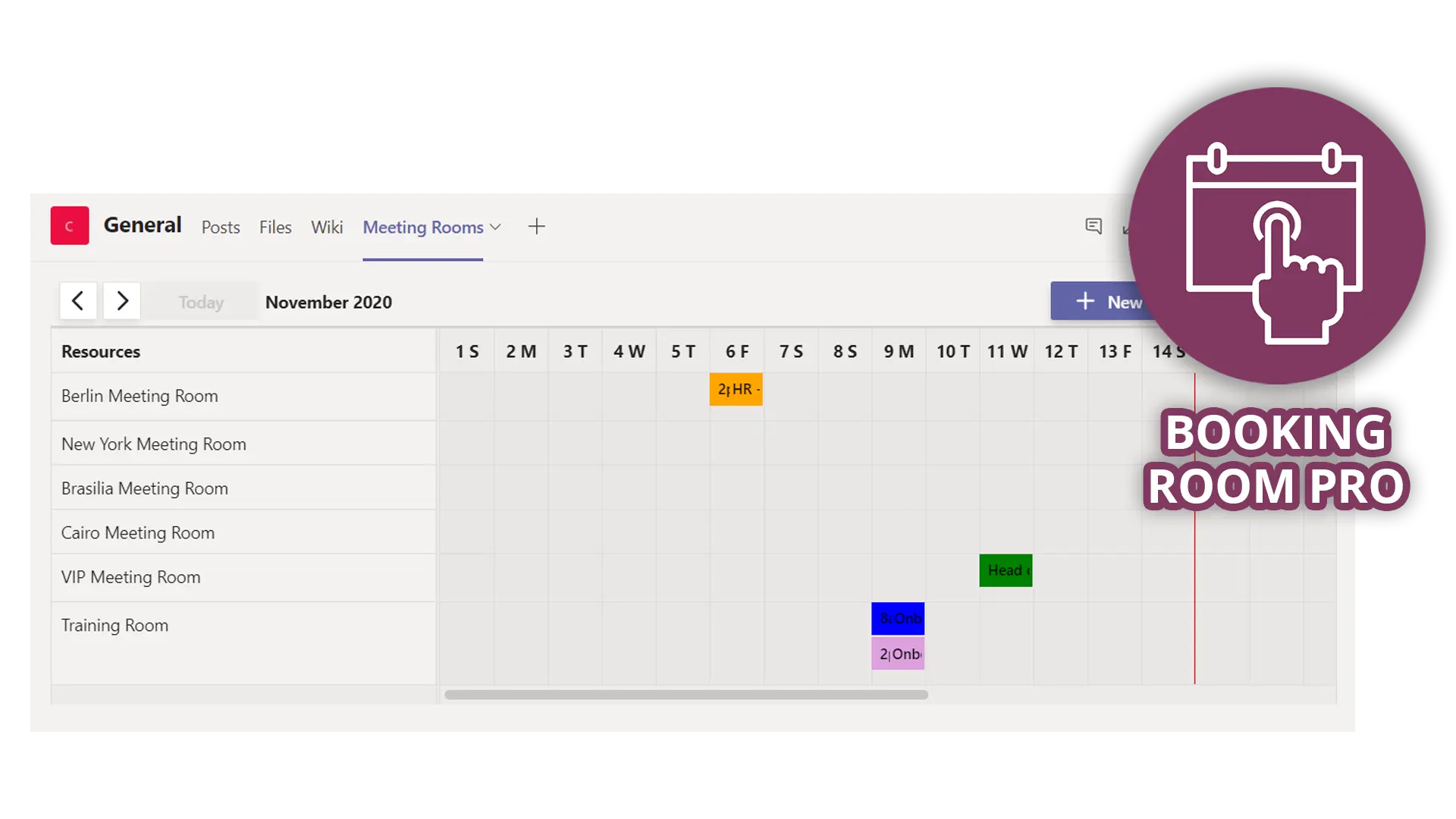
Rule four needs one shared place where drivers see and claim slots, and your people already spend the day in Microsoft Teams. Parking Pro is a workplace parking app for Microsoft Teams: people reserve named places from a tab in a channel. For chargers:
Add Parking Pro as a tab in a channel every registered driver belongs to, then use Manage places to create one place per charger, such as EV charger 1.
Drivers select a time slot in the view to create a booking, so a charger is claimed for a slot, not for the day.
The free plan includes up to 3 parking places and unlimited single reservations, enough for a small charger bank. Premium adds unlimited places, recurring reservations and tags that filter the parking view.
Be clear on what it is: a booking board, not charger software. It does not connect to the charger, start or stop a session, or know when a battery is full, so rules two and five still run on people. If the chargers are a daily argument, install Parking Pro in Microsoft Teams and open the chargers for booking next week.
Schedule the chargers before you buy more
By our math, a typical commute needs one to two hours on a 7.2 kW Level 2 port. Held all day, a port serves one driver; shared in slots, up to four. Write the five rules, run bookable slots for a month, then count again. If the queue survives, you have evidence for more power or more ports. For the rest of the lot, see our guide to office parking utilization, or try Parking Pro free.
Frequently asked questions
How long should employees charge at work?
By our calculation from FHWA, EPA and DOE figures, a typical US commute of about 13.5 miles each way needs 1 to 2 hours on a 7.2 kW Level 2 port to restore the day's driving, before charging losses. Public templates such as the DOE sample policy cap sessions at about four hours. Low-power ports near 2.9 kW need longer.
Should workplace EV charging be free?
Many employers make it free: CBRE reports that on the ChargePoint network, 63% of workplace chargers are free for authorized users. The DOE suggests pricing slightly above local residential electricity rates, which may help relieve congestion. IRS Publication 15-B does not mention EV charging, so check the tax treatment with your advisor.
Can employees unplug someone else's car?
Only if your policy says so. NYSERDA says unplugging is typically only appropriate once a car has been fully charged, and the DOE sample policy has drivers consent to being unplugged when the station shows a full charge.
How many employees can share one EV charger?
By our arithmetic, on an 8-hour workday a port held all day serves one driver, 4-hour caps serve two, and 2-hour bookable slots serve up to four if cars move. Beyond about four drivers per port who each need a daily charge, you likely need more ports or more power.